How to Check Your Credit Score for Free

Updated 22 September 2025
Check Your Credit Score and Credit Report for Free
Your credit score and credit report are essential tools that help lenders understand how you manage money. Whether you are applying for a credit card, a loan, a mortgage, or even car leasing, companies will review your credit file to decide if they should approve your application and what terms to offer.
With a poor credit score, you may be refused or offered higher interest rates, while a strong score gives you access to better deals. The good news is that you can check your credit score and report for free as often as you like.
This guide covers:
- Who Compiles Credit Reports?
- Credit Score Bands in the UK
- What is in your credit report?
- Who looks at your credit report?
- How to check your credit score for free
- Why it’s important to check regularly
- Correcting errors on your report
- Further help and resources
1 Who Compiles Credit Reports?
Credit reports in the UK are compiled by Credit Reference Agencies (CRAs). These companies track your borrowing and repayment history. The three main CRAs are:
- Experian – the largest agency, widely used by lenders.
- Equifax – holds extensive data on millions of customers.
- TransUnion – the newest UK agency.
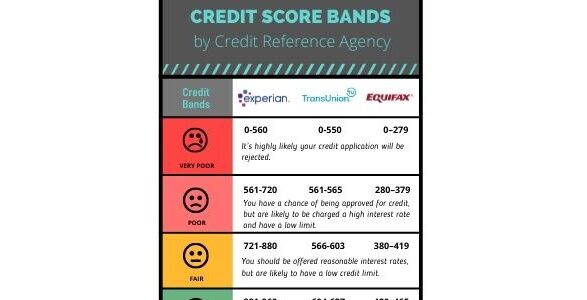
Each CRA uses its own scoring model. Your score can therefore differ slightly across them, even though all use the same rating bands from Very Poor to Excellent.
Credit Reference Agencies (CRAs) are companies who are allowed to collect and keep information about consumers’ borrowing and financial behaviour.
2 Credit Score Bands in the UK
| Credit Agency | Very Poor | Poor | Fair | Good | Excellent |
|---|---|---|---|---|---|
| Experian | 0-560 | 561-720 | 721-880 | 881-960 | 961-999 |
| Equifax | 0-279 | 280-379 | 380-419 | 420-465 | 466-700 |
| TransUnion | 0-550 | 551-565 | 566-603 | 604-626 | 627-710 |
Note: CRAs do not make lending decisions. They supply the data; the lender decides.

3 What Is in Your Credit Report?
Your credit report is a six-year history of your financial activity. It typically includes:
- Personal details (name, date of birth, addresses).
- Credit agreements – including loans, mortgages, credit cards, and utilities.
- Payment history – whether payments were made on time.
- Financial associations – e.g., partners or joint account holders.
- Public records – court judgments, bankruptcies, IVAs or Trust Deeds.
- Electoral roll data – confirming your residential address history.
- Search history – companies who’ve accessed your file in the last 12 months.
- Fraud markers (CIFAS) – either to protect you or if you’ve committed fraud.
Your report does not include your income, medical history, religion, or criminal record.
4 Who Looks at Your Credit Report?
Only organisations with a valid reason can access your file. These include:
- Mortgage lenders – to assess long-term repayment ability.
- Car leasing and finance companies – to check creditworthiness and risk.
- Credit card and loan providers – to decide if and how much to lend.
- Mobile phone and utility companies – checking reliability for monthly payments.
- Landlords and letting agents – confirming identity and risk.
- Insurance companies – some base premiums on credit history.
- Debt collection agencies – if a debt has been transferred to them.
- Government agencies – for crime prevention or tax collection.
- Some employers (mainly in financial services) – as part of pre-employment screening.
5 How to Check Your Credit Score for Free
You should review your credit report at least once a year—or always before applying for major finance like a loan, mortgage, or car lease. Checking will never harm your score.
There are three main ways:
i. Paid Subscriptions
All three CRAs offer premium subscriptions (often starting with a 30-day free trial). These services aren’t necessary, as you can access similar information for free.
ii. Free Statutory Reports
By law, all CRAs must give you a free statutory credit report. This contains your credit history but does not include a score.
iii. Free Credit Monitoring Services
Easier to use and updated frequently, these give you both your credit report and score:
- Experian – MSE Credit Club (monthly updates).
- Equifax – ClearScore (monthly updates plus credit product matching).
- TransUnion – Credit Karma (weekly updates) or Credit Monitor (monthly updates).
Tip: It’s smart to check all three, as different lenders use different agencies.
6 Why It’s Important to Check Regularly
- Spot mistakes – Incorrect details could damage your score.
- Stop fraud early – See if accounts or searches appear you don’t recognise.
- Prepare for applications – Knowing your score helps when applying for credit.
- Build notice of correction – Add context if past debts were resolved but still appear.
7 Correcting Errors on Your Report
If you find errors:
- Write to the CRA and request corrections.
- Provide supporting documents if available.
- Add a notice of correction if needed, explaining circumstances.
You cannot remove accurate information just because it is negative.
8 Further Help and Resources
- Money Advice Service – impartial advice.
- Experian | Equifax | TransUnion – direct CRA help.
- CIFAS – fraud protection.
- Action Fraud – report identity theft.
- Registry Trust – check court judgments against your name.
Back to all help and advice articles